3D TRACKINGAIM TRAINER
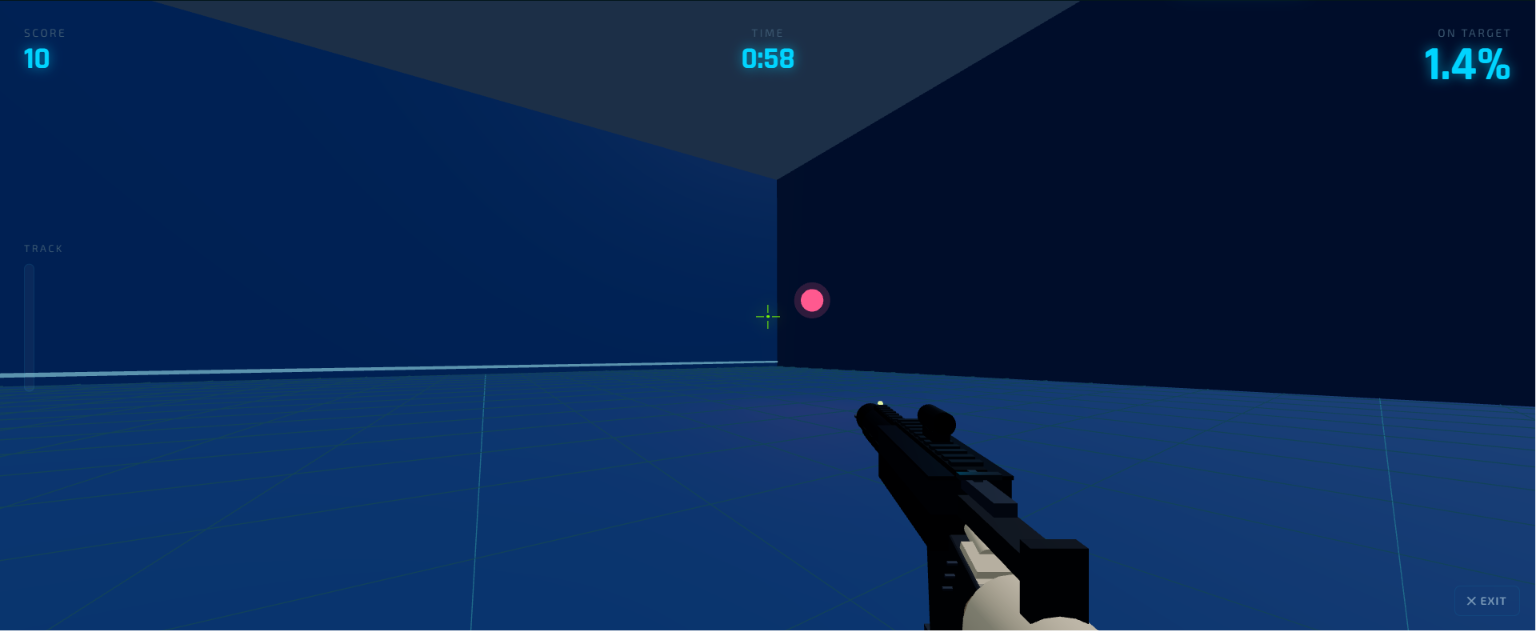
A 3D aim trainer for tracking: lock the pointer, drop into a first-person arena, and keep your crosshair glued to a target that strafes and shifts depth for a full 60 seconds. The closest browser feel to a real strafe duel — free, no download.
Sustain Your Crosshair on a Moving Target in Full 3D
Most aim drills test a single click. 3D tracking tests the seconds in between — the stretch of a fight where you have to hold a moving enemy under your crosshair while they juke, peek depth, and try to break your aim. This is a 3D aim trainer built around that one demand: a target moves continuously through a first-person arena, and the only thing you have to do is stay on it.
Because the camera is pointer-locked, your mouse rotates the view exactly like an FPS rather than dragging a cursor across a flat plane. Sessions run 60 seconds, and your streak and score climb the longer you keep the target centered — so the trainer rewards sustained control, not a lucky snap.
How 3D tracking works here
When you start, the browser captures the pointer and your screen becomes a first-person camera — there is no on-screen cursor to chase. Mouse motion turns the view in yaw (left/right) and pitch (up/down), and the crosshair stays fixed at center. To aim, you move the whole world under that crosshair, which is the same input model every competitive shooter uses.
A single target travels through the arena on a path that changes direction and depth — it drifts nearer and farther, not just side to side, so the speed it appears to move across your screen keeps changing. Your task is to keep the center crosshair covering it. The session lasts 60 seconds, and an uninterrupted run on target builds your streak and lifts your score, while slipping off resets the reward and tells you to settle your aim back down.
Smooth pursuit in a 3D arena
Good 3D tracking is smooth pursuit: your view glides at roughly the speed the target is moving, so you're matching its motion rather than reacting to it after the fact. When a target strafes, you don't wait for it to leave the crosshair and then yank back — you lead it slightly and let your camera travel with it, feathering tiny corrections only when it changes direction.
This is the skill that decides fights in Apex Legends and Overwatch, where opponents strafe constantly under sustained fire and the player who keeps more bullets on target wins the trade. Practicing it in a real first-person view — with depth changes and a fixed center crosshair — transfers far more directly to those duels than dragging a dot across a 2D canvas ever could.
Sensitivity for 3D tracking
Tracking generally favors a lower sensitivity than flicking. A slower turn rate lets your arm produce long, even sweeps, which is exactly the motion a strafing target demands — high sensitivity tends to turn smooth pursuit into a series of twitchy overcorrections.
What matters most is consistency: set this trainer to the same effective sensitivity you play your main game at, so the muscle memory you build here is the muscle memory you use in ranked. As broad guidance, many players land somewhere around 200–400 eDPI, but treat that as a starting point — pick a value that lets you complete a slow sweep across the arena without lifting or running out of mousepad, then leave it alone long enough to adapt.
Common 3D tracking mistakes
- Jittery micro-corrections: constantly twitching the mouse to recenter makes your aim shake around the target instead of riding it. Aim for one smooth motion and correct gently, not in rapid stabs.
- Falling behind a strafing target: if you only react after it has already moved, you're always a beat late. Lead the strafe slightly and match its speed so the target sits in your crosshair, not just behind it.
- Gripping the mouse too tight: a tense hand kills the fine, fluid motion tracking needs. Relax your grip so your arm and wrist can glide.
- Sensitivity set too high: if every correction overshoots, your turn rate is fighting you. Lower it until long, controlled sweeps feel natural before chasing a harder target.